Gallows Point Sussex history is one of the most chilling chapters written into the coastal landscape of East Sussex. This exposed clifftop site once served as a public execution ground, where the bodies of convicted criminals were left on display as a warning to those who dared break the law. From its role in punishing smugglers to its eerie presence in local folklore, the site carries centuries of dark memory that still draws historians and curious visitors today.
Gallows Point Sussex history: The dark origins
The story behind this notorious location reaches back to a time when English law was brutal and deliberately visible. Executions were not hidden affairs — they were civic spectacles designed to deter crime through fear and public shame.
Why clifftops were chosen for execution sites
Gallows Point Sussex history begins with a simple but grim logic: visibility. Clifftop locations like this one were selected precisely because they could be seen from both land and sea, ensuring that sailors, traders, and travellers all received the same unspoken message from the authorities. The elevated position meant that gibbeted bodies would sway in the coastal wind for miles around, turning the landscape itself into a warning. No passerby — whether on horseback or aboard a vessel — could miss the grim silhouette against the Sussex sky.
The legal framework behind public executions
Under English law during the 17th and 18th centuries, capital punishment extended far beyond murder to include theft, forgery, and smuggling. The Murder Act of 1752 formally allowed judges to order that executed bodies be gibbeted — hung in iron cages after death — as an additional deterrent. This practice transformed execution sites into long-term landmarks of terror, and Gallows Point Sussex history fits squarely within this brutal legal tradition. The site was not an anomaly but rather a reflection of how the Crown enforced its authority along vulnerable coastlines.
Early recorded use of the site
Historical parish records and county documents from Sussex suggest that the clifftop area near Rottingdean was used for punishment as far back as the late medieval period. While precise dates are difficult to pin down with certainty, the name “Gallows Point” itself serves as a form of historical evidence — place names in England rarely carry such references without genuine cause. Gallows Point Sussex history is therefore embedded in the very geography of the region, preserved in the name long after the wooden structures themselves rotted away.
Gallows Point Sussex history and the smuggling era
Perhaps no period shaped this location more dramatically than the height of the Sussex smuggling trade. The 18th century saw organised gangs operating with remarkable boldness along this stretch of coastline, and the authorities responded with increasing severity.
The Sussex smuggling gangs and their brutal fate
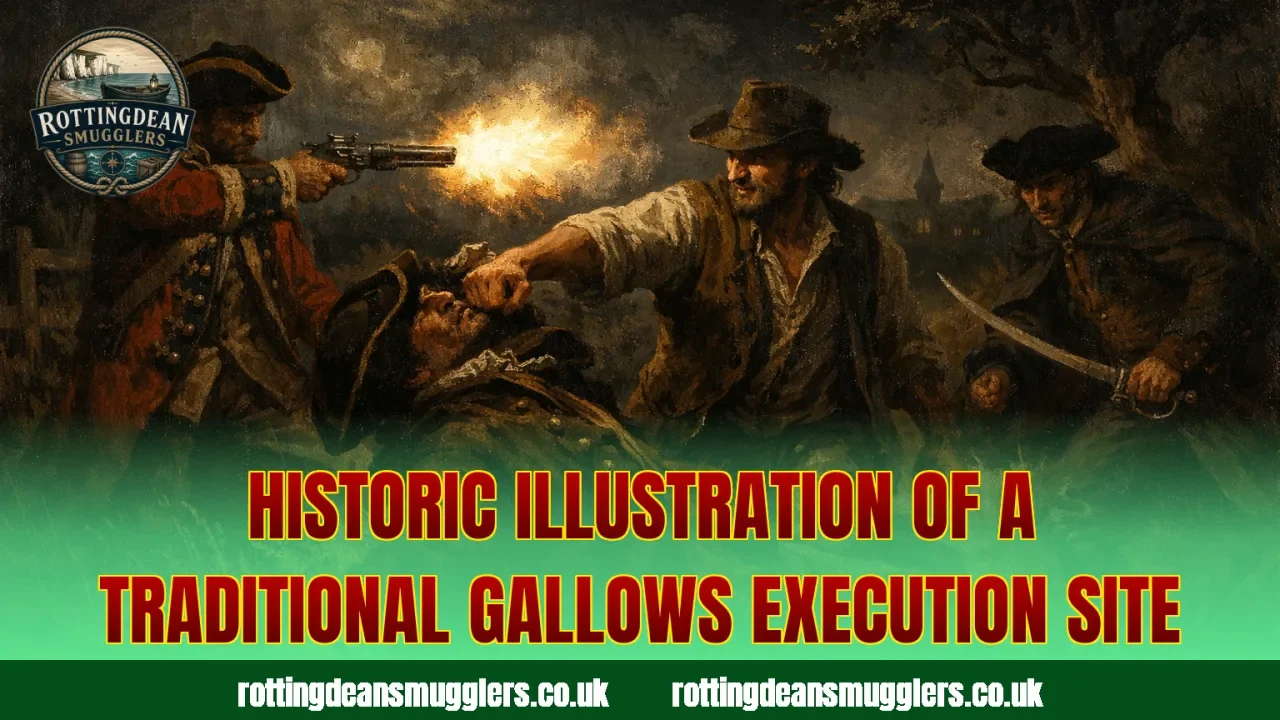
The Hawkhurst Gang and other notorious smuggling operations terrorised the Sussex coast during the mid-1700s, bribing officials and intimidating witnesses. When the Crown finally cracked down, the punishment was swift and public. Gallows Point Sussex history is directly tied to this crackdown, as convicted smugglers were executed and their bodies displayed at prominent coastal points to discourage their former associates. The sight of a gibbeted smuggler hanging above the cliffs was intended to shatter the romantic image of the “free trader” and replace it with something far more sobering.
How gibbeting reinforced coastal authority
Gibbeting — the practice of displaying a body in an iron cage post-execution — was particularly favoured for crimes committed near the coast. Revenue officers and Customs men pushed for maximum visibility, and clifftop sites like this one provided exactly that. The iron cage would be custom-fitted to the body and then hoisted onto a tall post, where it could remain for years. Gallows Point Sussex history includes accounts of such displays lasting long enough to become local landmarks in their own right, referenced in travellers’ journals and regional maps of the period.
Local community reactions and oral traditions
Not everyone in the surrounding villages viewed these executions with the horror that authorities intended. Many locals had family ties to smuggling networks, and the executed men were sometimes regarded as martyrs rather than criminals. Over generations, stories were passed down through families in Rottingdean and neighbouring settlements, weaving Gallows Point Sussex history into the fabric of local identity. These oral traditions preserved details that official records often omitted, including the names of those hanged and the circumstances that led them to the gallows.
The folklore and ghost legends of the site
No execution site of this age escapes the accumulation of ghost stories and supernatural legend. The clifftop location, combined with centuries of dark association, has made this one of the most talked-about haunted spots in East Sussex.

Phantom sightings and local ghost accounts
Residents and walkers near the clifftop have reported strange experiences over the years, including the sound of chains rattling on calm nights and shadowy figures near the cliff edge. Whether these accounts reflect genuine paranormal activity or the power of suggestion shaped by history is a matter of personal belief. What is certain is that Gallows Point Sussex history has generated enough ghost lore to feature in several regional books on Sussex haunts and supernatural folklore. The stories themselves are a form of living history, keeping the memory of the site alive in popular culture.
How folklore preserves historical memory
Historians increasingly recognise that folklore, even when exaggerated, often contains a kernel of historical truth. The ghost stories attached to this clifftop site echo real events — real people were executed here, real bodies were displayed, and real communities were traumatised or divided by what they witnessed. Gallows Point Sussex history survives partly because these legends refused to die, passed from generation to generation in pubs, schoolyards, and family kitchens. In this sense, the supernatural stories are not a distraction from history but a continuation of it.
The site’s role in modern dark tourism
Today, the location attracts visitors interested in what has become known as “dark tourism” — travel to sites associated with death, tragedy, or historical violence. Walking the clifftop path, it is possible to stand where condemned men once stood and look out over the same Channel waters their bodies once overlooked. Gallows Point Sussex history has become a point of genuine historical pilgrimage for those researching smuggling, criminal justice history, and the social history of coastal England. The site offers no dramatic monument, but its atmosphere is unmistakable.
Key historical facts about the execution site
The following table summarises the most important documented details associated with this location, drawing on county records, local historical society research, and published Sussex history texts.
| Category | Details |
|---|---|
| Location | Clifftop near Rottingdean, East Sussex, England |
| Primary period of use | 17th to early 19th century |
| Main crimes punished | Smuggling, theft, murder, forgery |
| Execution method | Hanging, followed by gibbeting in iron cages |
| Legal authority | English Crown courts, Assizes of Sussex |
| Notable connection | Rottingdean smuggling networks, Hawkhurst Gang era |
| Current status | Open coastal path, no formal monument |
| Historical significance | Reflects 18th-century penal policy and coastal enforcement |
Conclusion
Gallows Point Sussex history stands as a powerful reminder of how the English state once used public terror to maintain order along its most lawless coastlines. The clifftop site near Rottingdean connects the dots between brutal penal law, the golden age of smuggling, and the living folklore that still surrounds this windswept stretch of East Sussex. For anyone passionate about coastal history, criminal justice, or the darker corners of English heritage, visiting this location — and exploring the broader story through Rottingdean Smugglers — is an experience that genuinely deepens your understanding of the past.
Xem thêm: Rottingdean history timeline – Chronology Of Legends